

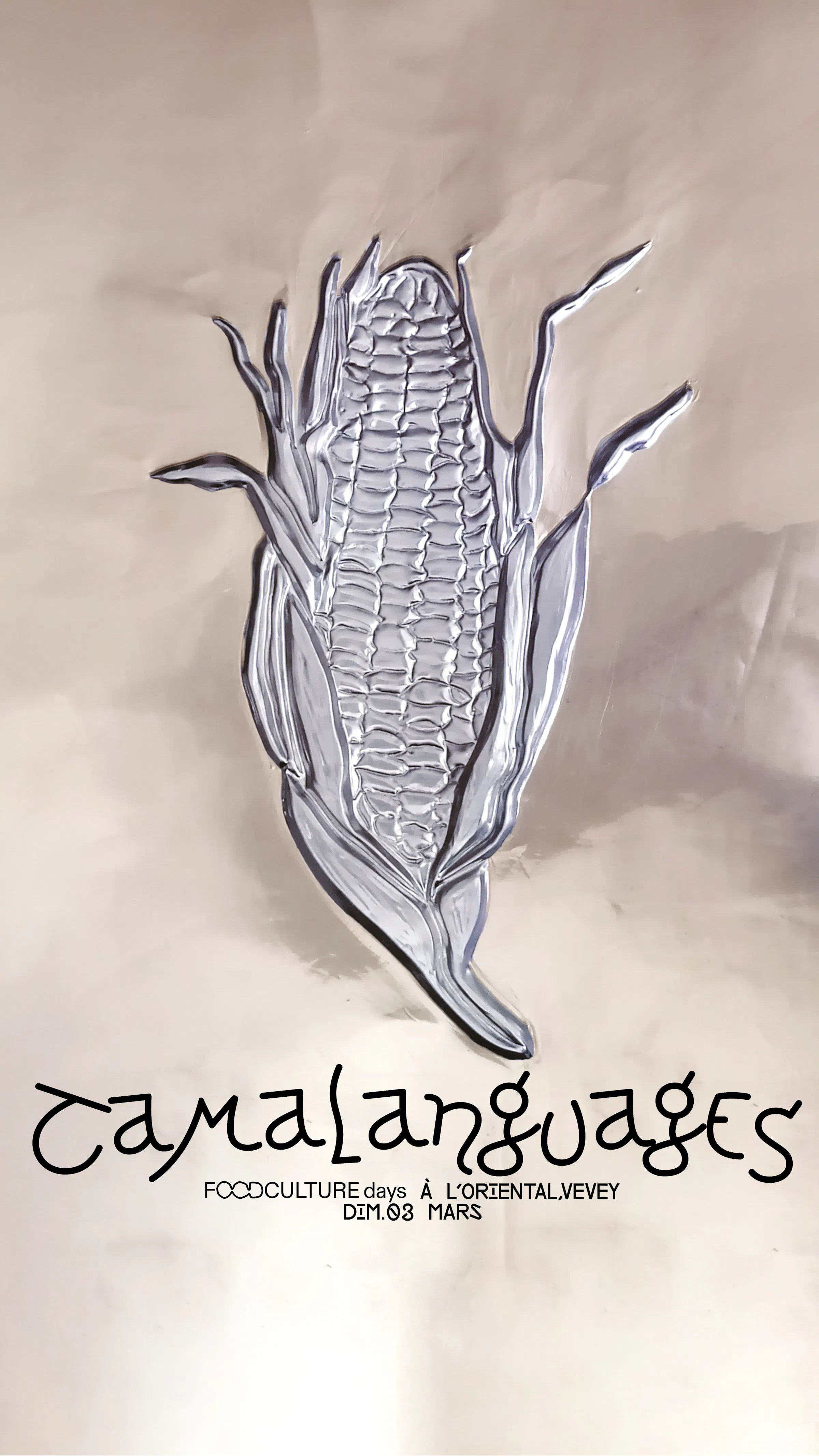
archive

TAMALANGUAGESGrace Denis x foodculture days
Activation in the Public Space, Workshop, Thematic Meal, Participatory performance
Théâtre de l'Oriental - 1800 Vevey
Tamales preparation workshop and "Latin oralities" discussion with artist Grace Denis followed by a convivial Mexican meal
Live music: Coco & guests
Tamalanguages is the fruit of discussions and reflections between Grace Gloria Denis & the foodculture days team.
How can we connect sensitively with others and let other worlds emerge through cuisine?
Through this convivial day around the table, tamal and ancestral Mesoamerican food cultures, foodculture days and artist Grace Denis invite you to exercise the many ways in which we can engage our bodies in the transmission of knowledge and know-how in a collective and joyful way.
Tamal is a traditional Mesoamerican dish made from masa, a dough made from nixtamalized corn, which is steamed in a corn or banana leaf. The Aztec and Mayan civilizations, as well as the Olmec and Toltec civilizations before them, used tamales as an easily transportable food for hunting parties and long-distance travel. But how has the tamal evolved over time, particularly in the face of industrialization?
"Together with the public, we fabricated two hundred tamales during Tamalangues. The workshop included two modes of fabrication; the first with Chalqueño and Bolita corn from Tamoa nixtamalized over two days preceding the event with Aziadé Circlini at Café des Argiles, the second being a pre-nixtmalized and pre-ground harina de maiz. Nixtamalization is the process of preparing maiz to be more malleable, increasing its nutritional value, as well as reducing the mycotoxins. The process entails soaking and cooking in an alkaline solution, usually lime or ash, subsequently draining and at times removing the pericarp.
These two modalities of processing elucidated the increasing industrialization of Mexican foodscapes, accelerated by the implementation of NAFTA in 1994, which generated a large-scale deviation from traditional milpa-based cuisine that relied heavily on the hands of women. In her book, Eating NAFTA: Trade, Food Policies, and the Destruction of Mexico, Alyshia Gálvez critiques the notion of efficiency, a concept tethered to the globalized industrial agriculture system, stating that if we define efficiency as the ratio of what we put into something to how much we get out of it, then small-scale milpa-based farming is far more efficient than industrial agriculture. Under NAFTA, the binational relationship between the United States and Mexico has ruptured traditional foodscapes, affecting what lands on our plates and how it gets there.
During Tamalangues, we discussed industrialization, trade, and gendered labor while simultaneously grinding the masa on a metate installed on the sidewalk, inviting the public to engage in the rendering of the maiz into masa. The resulting masa, ground by forty transgenerational pairs of hands, was cooked at the end of the day, illuminating the contrast of pre-nixtamalized corn versus corn derived directly from the field." - Grace Denis
OUR PRODUCERS:
Maïs Azul & Cream: Tamoa (Oaxaca)
Sauces: Praz Bonjour (Vevey)
Urban Mushroom: Mission Mycelium (Vevey)
Grace Gloria Denis est une artiste qui fait converger ses recherches sur les terrains agricoles avec des installations interactives. Elle associe aliments comestibles et sons pour proposer des projets conviviaux et sensoriels qui questionnent notre rapport à la consommation. Sa pratique se réfère à des modèles de recherche participative et implique des collaborations avec les acteur.ice.s des systèmes alimentaires locaux sur le long terme. Grace a des origines mexicaines du côté maternelle et a vécu durant deux ans à Mexico City.
Since 2017, foodculture days' mission has been to support environmental and social justice through cultural and artistic projects. We take the opportunity of this post to show our solidarity with the various resistance movements fighting for access to their land, their food sovereignty, their autonomy and their dignity on a daily basis: whether in Europe with the recent agricultural protests and all the way to Palestine, where agriculture has a prominent place in the country's heritage, linking producers/keepers of the land to the food landscapes that nourish them and which are now being brutalized.